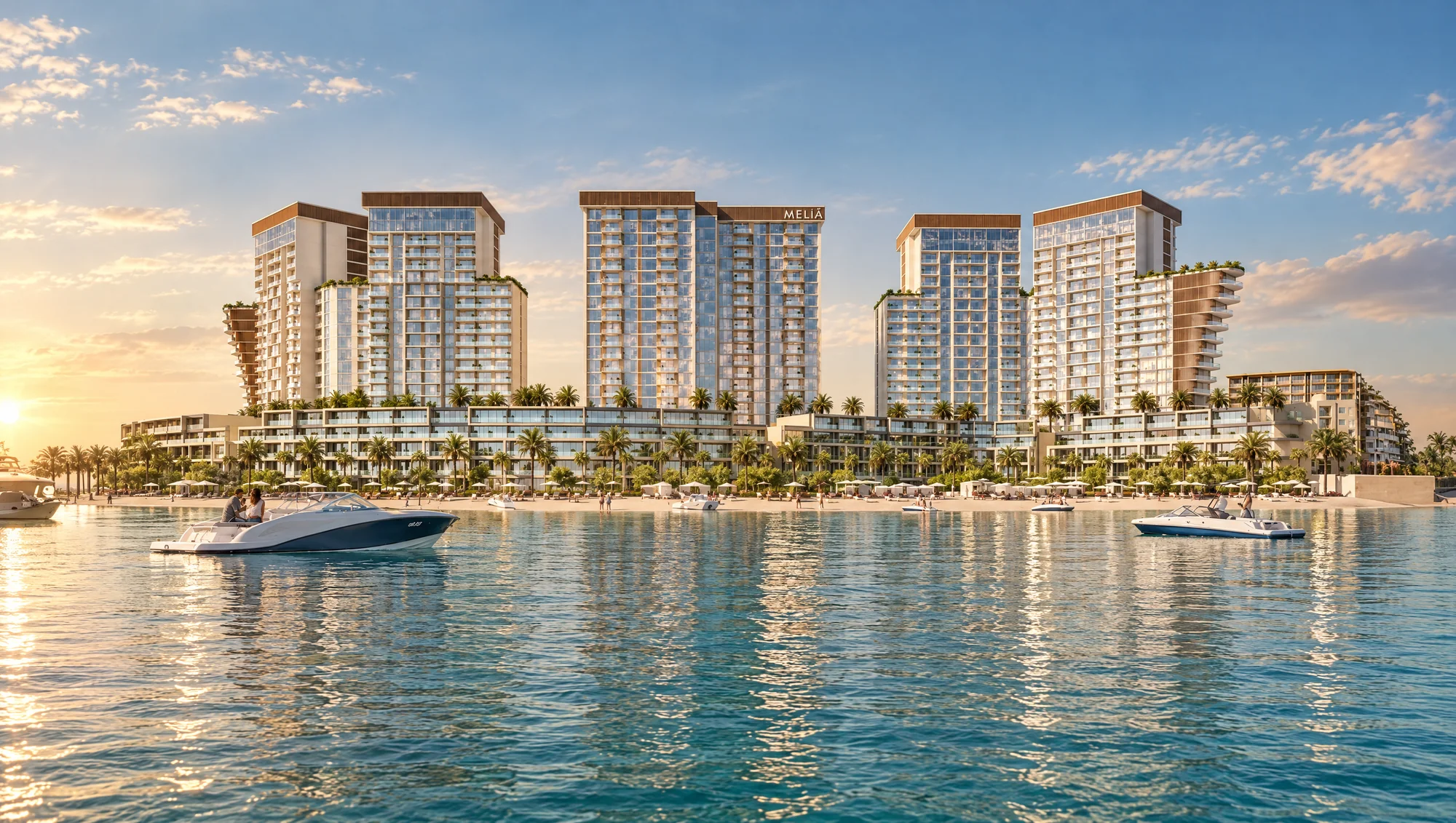
A PLACE PEOPLE CHOOSE. AN INVESTMENT YOU UNDERSTAND.
The view gets your attention. The business behind it matters.
A beautiful apartment starts the conversation. The investment case asks what makes a guest book it, who runs it, what it costs and how income reaches you. Meliá Beachfront brings those questions together in a hotel-led coastal destination.
The opportunity is a combination: an established Spanish hospitality identity, Amwaj’s shoreline and a richer experience around the stay. Your decision comes down to how well that appeal translates into performance at the price you pay.
01 / THE AMWAJ EFFECT
From a place on the map. To a reason to make plans.
Picture a weekend built around the shoreline: check in, head to the beach, meet friends at Beso, stay for another slow morning. That is the destination ambition—giving people several reasons to come, and more to enjoy once they arrive.
Meliá’s announced hotel and beach role, alongside the Beso partnership, could broaden how visitors see Amwaj. The investment logic is stronger guest appeal and a more recognisable address. The commercial test is whether that creates bookings at rates that cover the costs and reward owners.
Three reasons to choose the stay. Three things for an investor to measure.
01 / Recognition
A name that travels.
Meliá brings international hospitality experience and a global leasing platform to the announced proposition. That can help the destination reach guests beyond the local property market.
Watch: booking demand and distribution costs.02 / Experience
More behind the booking.
A beach, a well-run stay and a distinctive social scene give guests reasons to choose the address. Beso can add destination appeal; it does not automatically add beach-club revenue to your pool.
Watch: achieved room rates and repeat stays.03 / Operation
The stay is a business.
Pricing, housekeeping and guest care need a consistent operator. Professional management can reduce the owner’s daily workload; its value needs to show after management and operating costs.
Watch: net distributions and cost control.
02 / THE RENTAL POOL, EXPLAINED
Many rooms. One operation. Your agreed share.
The hotel apartments are let through nightly stays. Rental income from participating accommodation flows into a common pool. After the agreed deductions, your allocation is the distributable amount multiplied by your eligible square metres, divided by the total eligible square metres in the pool.
Think of it as a team of rooms. Some may be busier than others, but the sharing rules determine each owner’s allocation. Pooling spreads individual-room vacancy exposure; it does not remove the risk of a quiet hotel.
01OWNERSHIP FIRST
FOLLOW THE MONEY / 01
You buy a property interest.
Your purchase pays for the unit or ownership interest described in the sale agreement. A rental-management agreement then sets out how an eligible unit participates in the hospitality operation. The property purchase and the income arrangement are connected, but they are different contracts.
Teaching example: 50 eligible m² out of a 5,000 m² pool, for one illustrative month. Figures are not the actual pool size, costs or projected revenue. The model below lets you explore the area-based sharing system across different unit types.
Why could it perform well?
Coordinated pricing, broader booking reach and reliable guest service can support occupancy and room rates. Pooling then shares the results according to the contract. The operator creates and manages the opportunity; the pool is the mechanism for allocating it.
What could hold returns back?
Seasonality, competing hotels, slower demand, opening delays and rising operating costs. Higher gross revenue does not always mean higher net income. Service charges, refurbishment reserves and owner-use rules all belong in the calculation.
03 / NIGHTLY INCOME. SHARED BY SQUARE METRE.
The hotel opportunity. Now, do the maths.
A hotel apartment earns through nightly stays. At 50% occupancy, each available room sells an average of 182.5 nights a year. Model the income across every room category, account for costs, then allocate the pool by the square metres you own.
The payment plan changes when your capital is committed. It can increase the income return measured against cash paid during the plan, while the unpaid purchase balance remains due.
YOUR SCENARIO / EVERY INPUT IS EDITABLE
Illustrative pool, not an inventory or income forecast. Unit counts, areas, purchase prices, larger-unit rates and costs below are sample assumptions. Replace them with the actual eligible pool schedule and your unit quotation. The 50% starting occupancy is the scenario requested, not measured occupancy at either hotel.
BHD per occupied night, in studio / 1 / 2 / 3-bedroom order. Buttons change rates only; all other inputs stay editable. These are sensitivity cases, not probability ranges. Stress-test occupancy and additional operating costs too.
PAID ANNUALLYBHD 14.40 / m²
Monthly rate × 12. Annual service charge = unit area × annual rate.
The management fee is an assumed 15% of gross room revenue, not an agreed operator fee. Service charges are calculated separately at BHD 1.20 per m² per month, paid annually (BHD 14.40 per m² per year). The model uses the unit area shown above as the chargeable area. Other owner costs start at zero: add any operating, distribution, reserve or other charges not covered by these fees. Returns are after the costs entered only; confirm the full cost schedule and chargeable area for your unit. Service charges continue at zero occupancy.
Build the pool · rates exclude guest taxes and pass-through charges
Category
Units in pool
Eligible m² / unit
Nightly BHD
Purchase BHD / unit
Studio
1 bedroom
2 bedrooms
3 bedrooms
ANNUAL ROOM REVENUEBHD 1,409,813
−
MANAGEMENT FEEBHD 211,472
=
DISTRIBUTABLE POOLBHD 1,198,341
BHD 1,198,341 ÷ 6,400.00 eligible m² = BHD 187.24 per m² / year
YOUR STUDIO / 40.00 m²
Your area. Your share of the pool.
40.00 m² ÷ 6,400.00 m² = 0.625% of the distributable pool. Your selected unit is assumed to be one of the units already in the pool above.
Allocation: BHD 7,490 Annual service charge: BHD 576.00 Other owner costs: BHD 0 Illustrative annual net income: BHD 6,914
NET YIELD / FULL ACQUISITION COST9.88%
BHD 6,914 annual net income ÷ BHD 70,000 total acquisition cost
Zero additional costs is the starting assumption. Add confirmed purchase and furnishing costs; no capital growth is included.
HOTEL POOL VS LONG-TERM RENTAL
Compare net with net.
The 6%, 7% and 8% alternatives are editable comparison scenarios—not verified Bahrain market averages. Use annual rent after vacancy and all owner costs for a like-for-like comparison.
HOTEL POOL SCENARIOBHD 6,914
9.88% net / year
LONG-TERM SCENARIOBHD 4,900
7% net / year
Modelled difference: BHD 2,014 / year
15% DOWN / 70% OVER 7 YEARS / 15% AT THE END
Cash in. Cash out. The payment-plan effect.
ILLUSTRATIVE MONTHLY INSTALMENTBHD 583.33
Down BHD 10,500 · final BHD 10,500
Month 25 is an editable timing assumption, not a delivery forecast. Income is spread evenly through operating months for illustration. Actual opening, seasonal income and distribution dates will differ. Service charges are paid annually. This annual cash-flow illustration accrues costs from opening; it does not model invoice dates or advance bills. Budget any pre-opening charges separately.
YEAR 3 / INCOME RETURN ON PAID CAPITAL24.44%
BHD 6,914 income ÷ BHD 28,292 average cumulative purchase cash paid, including acquisition costs. Before this year’s purchase instalments.
YEAR 3 / CASH AFTER PURCHASE PAYMENTSBHD -86
BHD 6,914 net operating income − BHD 7,000 purchase payments.
The income ratio uses average month-end capital paid, without subtracting prior distributions. It is not an IRR or the return on the full asset. Purchase instalments build ownership but still consume cash. The unpaid balance remains your obligation.
See all eight years of cash flow
Year
Operating months
Net income
Purchase cash out
Cash remaining
1
0
0
17,500
-17,500
2
0
0
7,000
-7,000
3
12
6,914
7,000
-86
4
12
6,914
7,000
-86
5
12
6,914
7,000
-86
6
12
6,914
7,000
-86
7
12
6,914
17,500
-10,586
8
12
6,914
0
6,914
All amounts BHD. Acquisition costs and down payment occur in year 1; final 15% occurs at month 84. No sale, appreciation, financing charges or reinvestment assumed.
So, where does 10% come from?
It must come from the assumptions and the denominator. For this studio, a 10% net yield on the full BHD 70,000 acquisition cost needs BHD 7,000 net income a year. The current pool inputs produce BHD 6,914. A return above 10% on cash paid during the payment plan is a different measure and can occur with a lower full-price yield.
Nightly pricing creates the revenue opportunity. The area-based pool shares it. Operating costs determine the net income. The payment plan determines when you put capital in. Read those four pieces together.
WHAT YOUR MONEY DOES
Buy the asset. Understand the business around it.
YOUR PURCHASE PAYMENTS
Secure the agreed interest
Payments meet the purchase obligation for your selected property under its sale agreement. Confirm exactly what is included—fit-out, furniture, title and access rights—and the payment protections that apply.
THE OPERATING REVENUE
Comes from paying guests
Once accommodation is operating, eligible guest revenue enters the management or pool arrangement. Your purchase instalments are not rental income, and a payment plan does not itself create investment returns.
THE OWNER’S DISTRIBUTION
Is the result after the rules
The agreement determines deductible costs, reserves, sharing and when you are paid. Ask for a sample owner statement that connects the top-line revenue to the cash you would actually receive.
04 / COMPARE THE STRATEGY, AS WELL AS THE ADDRESS
Why here? Because the investment fits you.
Bahrain offers different property stories. Meliá’s distinction is the proposed combination of beachfront hospitality, destination dining and professional operation. Compare that with the alternative you would actually buy, using the same budget and net-income basis.
MELIÁ BEACHFRONT
A hospitality-led destination
The proposed combination of an international hotel brand, private beach and Beso experience speaks to people choosing a stay by the sea.
THE INVESTMENT LENS
For participating hotel units, assess operating performance, pool allocation, all fees and the owner’s net distribution.
Do I want professionally managed hospitality exposure, with its operating costs, trading variability and owner-use rules?
These are investment approaches, not neighbourhood yield rankings. No like-for-like data here establishes that Meliá will outperform other Bahrain properties. Compare purchase costs, net income, vacancy, fees, owner control and resale conditions.
THE FEELING. THE FUNDAMENTALS.
Love the idea. Know your numbers.
The best next step is a unit-specific conversation: the price, the pool, the costs and the payment dates—together in one clear picture.
No. Pooling can spread the effect of individual-room vacancy across participating owners. Professional pricing, distribution and service may support revenue, but fees and operating costs also matter. A weak trading period affects the whole pool. Compare net owner income, not headline room revenue.
How should I read a return of 10%?
First identify the denominator: full acquisition cost or cash already paid. Nightly rates, occupancy, pool deductions and your area share determine income. The payment plan can produce a higher income ratio on paid capital while the balance is still due. A 10% full-price net yield on BHD 70,000 needs BHD 7,000 annual net income. The calculator shows both measures and cash remaining after instalments; none is a guaranteed return.
Is my share based on how often my own room is occupied?
The area-based model shares distributable pool income in proportion to the eligible square metres you own: your unit area divided by the total participating area. Your share is not determined only by your own room’s bookings. Confirm eligible areas, participating inventory, owner-use adjustments and distribution timing in the agreement.
Can rental income pay my instalments?
It may contribute once operations and distributions begin, but the payment schedule is a separate commitment. Delayed opening, seasonal trading and payment timing can create a shortfall. Budget for all instalments and the final 15% without relying on projected rent.
Do I receive income from Beso Beach?
Beso is part of the destination’s appeal. Hotel-apartment ownership does not by itself give you a share of the beach club’s revenue. Only income explicitly included in your agreement belongs in your investment calculation.
What should I receive before choosing a unit?
Request the purchase agreement, rental-management and pool terms, allocation formula, itemised fees and reserves, owner-use rules, distribution timetable and a unit-specific financial illustration. Also confirm delivery dates, payment dates, resale conditions and the total acquisition cost.